Ambystoma maculatum
Scientific name. Ambystoma maculatum
Common Name. Spotted Salamander
General information. Ambystoma maculatum is rarely seen above ground. Many individuals can be seen congregating at one pond during breeding time.
Protected status. The Spotted Salamander is not a protected species in Texas and can be legally collected with a hunting license.
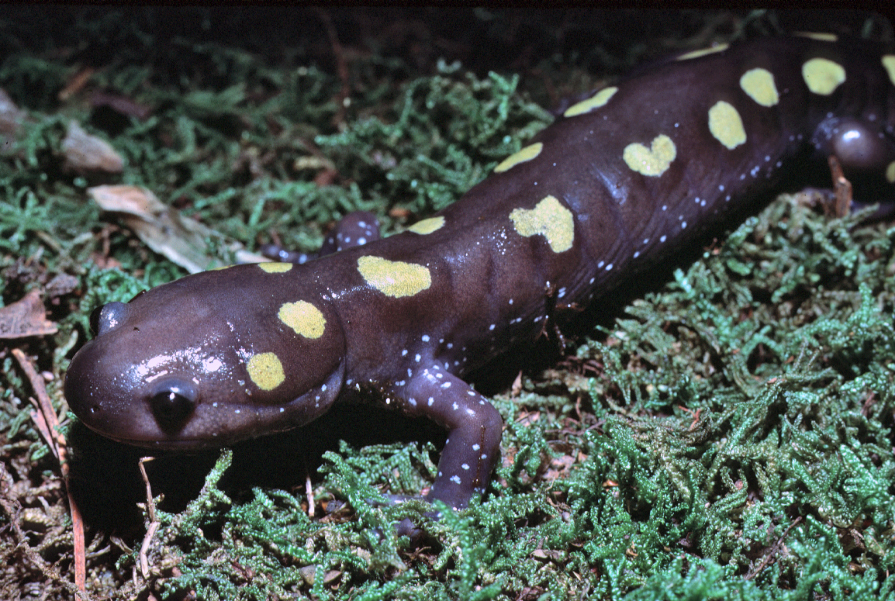
Diagnostic features. Large and stout salamander with a long, broad head. Tail slightly shorter than body length. Four toes on forelimbs, and five on hind limbs Twelve costal grooves
Coloration. Black or slate-colored ground color with orange or yellow spots in irregular rows down each side of body from head to tip of tail Gray ventral surface.
General distribution. In North America, Ambystoma maculatum has a broad range from Nova Scotia to south-central Ontario, south to Georgia and Texas.
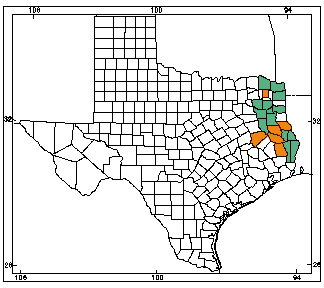
Texas distribution. In Texas, Ambystoma maculatum is found in the northern and central parts of east Texas.
Habitat. Ambystoma maculatum prefers moist environments and may be seen under boards or fallen logs, near permanent and temporary ponds.
Reproduction. Breeding in Ambystoma maculatum occurs in early spring with warm rains. Internal fertilization occurs and one or more egg mass is laid and attached to submerged vegetation.
Size. As an adult, Ambystoma maculatum can reach a total length of 15-25 cm (6-10 in).
Map. Orange counties indicate new county records since previous Herps of Texas update in 1998; all other colored counties reflect known distribution prior to 1998 for species and/or subspecies. Map is based on museum voucher specimens.