Ambystoma opacum
Scientific name. Ambystoma opacum
Common Name. Marbled Salamander
General information. Ambystoma opacum is rarely seen in water, but remains near it in moist areas.
Protected status. The Marbled Salamander is not a protected species in Texas and can be legally collected with a hunting license.
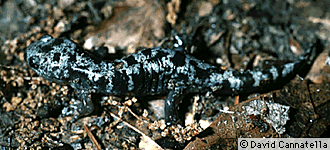
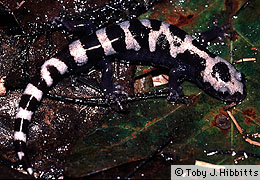
Diagnostic features. Large and stout salamander with a short, broad head Tail shorter than body length. Four toes on forelimbs, and five on hind limbs. Eleven or twelve costal grooves.
Coloration. Dark gray or black dorsal and ventral surfaces. Silver or white “crossbars” mark the dorsum, sometimes fusing with spots.
General distribution. In North America, Ambystoma opacum is found from New England to Florida and Illinois to Texas.
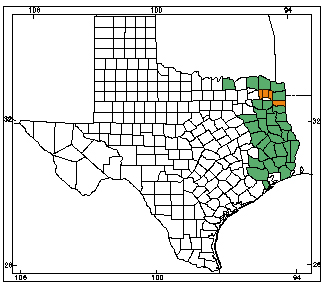
Texas distribution. In Texas, Ambystoma opacum is found in east Texas from the Red River to the Gulf of Mexico.
Habitat. Ambystoma opacum prefers drier environments than many salamander species, but it remains near water and is commonly seen in wooded areas.
Reproduction. Breeding in Ambystoma opacum occurs throughout the fall. Females lay 50-200 eggs on land and guard them until rainwater comes, triggering hatching.
Size. Ambystoma opacum grows to a total length of 7.5-12.5 cm (3-5 in) as an adult.
Map. Orange counties indicate new county records since previous Herps of Texas update in 1998; all other colored counties reflect known distribution prior to 1998 for species and/or subspecies. Map is based on museum voucher specimens.