Ambystoma tigrinum

Scientific name. Ambystoma tigrinum
Common Name. Eastern Tiger Salamander
General information. Nocturnal, Ambystoma tigrinum remains underground or under cover near water during the day. Ambystoma tigrinum feeds on earthworms, insects, and small vertebrates. Several may congregate near ponds during breeding times.
Protected status. The Eastern Tiger Salamander is not a protected species in Texas and can be legally collected with a hunting license.
Diagnostic features. Large salamander with broad flat head and small eyes. Four toes on front feet, and five on hind feet; hind feet have digging tubercles. Tail is long and flattened at tip Eleven to fourteen costal grooves.
Coloration. With a greater number of thinner and lighter yellow bars and spots on a black background than Ambystoma mavortium, almost with a reticulate pattern.
General distribution. In North America, the range of Ambystoma tigrinum is broken and scattered across the U. S., from the East Coast to Minnesota down to the Gulf Coast, through the Plains States to Nebraska and Texas.
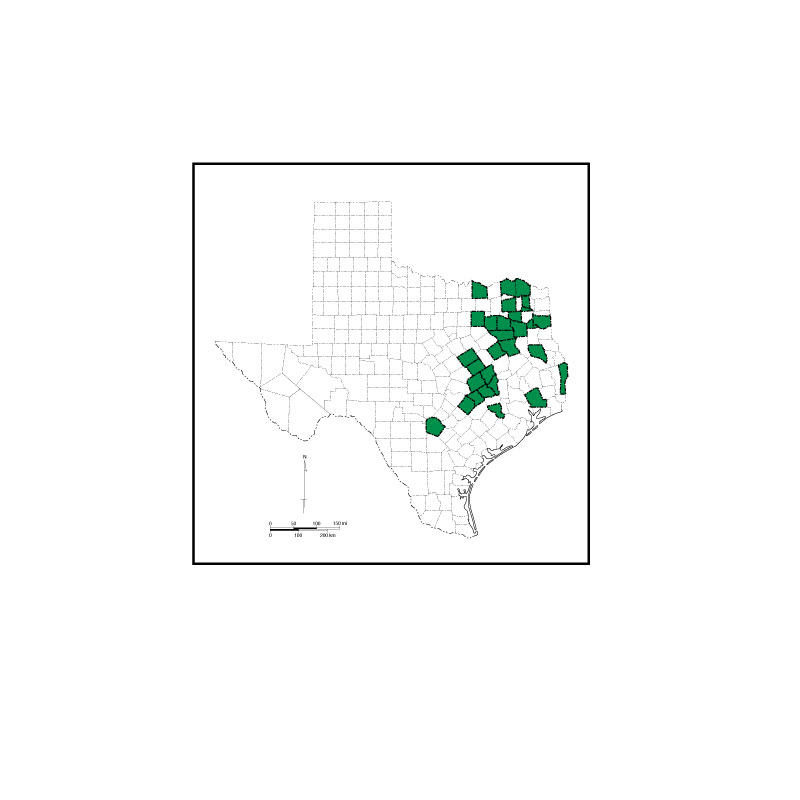
Texas distribution. Ambystoma tigrinum is found in the northeast corner of Texas.
Habitat. Ambystoma tigrinum can be found in moist environments or near water, wooded areas with loose soil, in cultivated lands near water, and in mammal or crawfish burrows.
Reproduction. Breeding in Ambystoma tigrinum typically occurs after late winter rains, but may occur anytime with sufficient rain. Eggs are attached to submerged vegetation and rocks singly or in masses.
Size. As an adult, Ambystoma tigrinum can reach between 18–33 cm (7–13 in) in total length.
Map. Orange counties indicate new county records since previous Herps of Texas update in 1998; all other colored counties reflect known distribution prior to 1998 for species and/or subspecies. Map is based on museum voucher specimens.