Aspidoscelis dixoni
Scientific name. Aspidoscelis dixoni
Common Name. Gray Checkered Whiptail
General information. This diurnal lizard actively forages for insects under low shrubs. Aspidoscelis dixoni is very wary, and quickly retreats to a nearby burrow if threatened.
Protected status. The Gray Checkered Whiptail is not a protected species in Texas and can be legally collected with a hunting license.
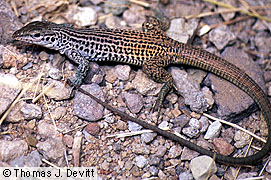
Diagnostic features. Slender lizard with small, granular dorsal scales Belly with 8 rows of large, rectangular scales
Coloration. Dorsal ground color is black. Dorsal pattern consists of 10-12 light stripes and a sprinkling of light colored scales, giving a checkered effect Tail at base and hips with rusty red coloration Ventral surface is white and unmarked.
General distribution. In North America, Aspidoscelis dixoni is restricted to two small populations, one in New Mexico and the other in Texas.
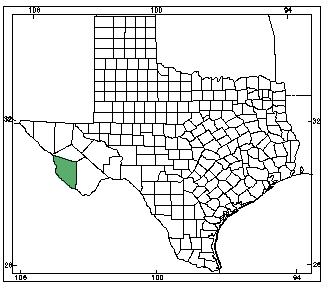
Texas distribution. Aspidoscelis dixoni is only found in a small part of Presidio County in the Big Bend region of Texas.
Habitat. This lizard can be seen in gravelly areas such as dry riverbeds and floodplains with sparse vegetation.
Reproduction. No males of Aspidoscelis dixoni exist, the species is entirely comprised of females. Reproduction occurs through parthenogenesis. Unfertilized eggs are laid in midsummer. Hatchlings appear six weeks later.
Size. Adult Aspidoscelis dixoni can grow to a total length 20-31 cm (8-12.5 in).
Map. Orange counties indicate new county records since previous Herps of Texas update in 1998; all other colored counties reflect known distribution prior to 1998 for species and/or subspecies. Map is based on museum voucher specimens.