Cemophora coccinea

Scientific name. Cemophora coccinea
Common Name. Scarletsnake
General information. Scarletsnakes can be constrictors, taking small lizards and snakes at times, preferring instead to feed on reptile eggs. They can feed on such eggs by swallowing them whole or by cracking the shell with specialized teeth in the back of their jaw.
Protected status. The Scarletsnake is listed as threatened by the Texas Parks and Wildlife Department and is protected in the state of Texas.
Diagnostic features. Undivided anal plate Smooth dorsal scales in 19 rows at midbody. Pointed red snout.
Coloration. Grey or white background color with 17-24 deep red blotches, with each blotch bordered by black pigment along the spine The ventral surface is white and unmarked.
General distribution. Scarletsnakes are found from New Jersey, along the Atlantic Coast to Florida, and west to Texas and Oklahoma
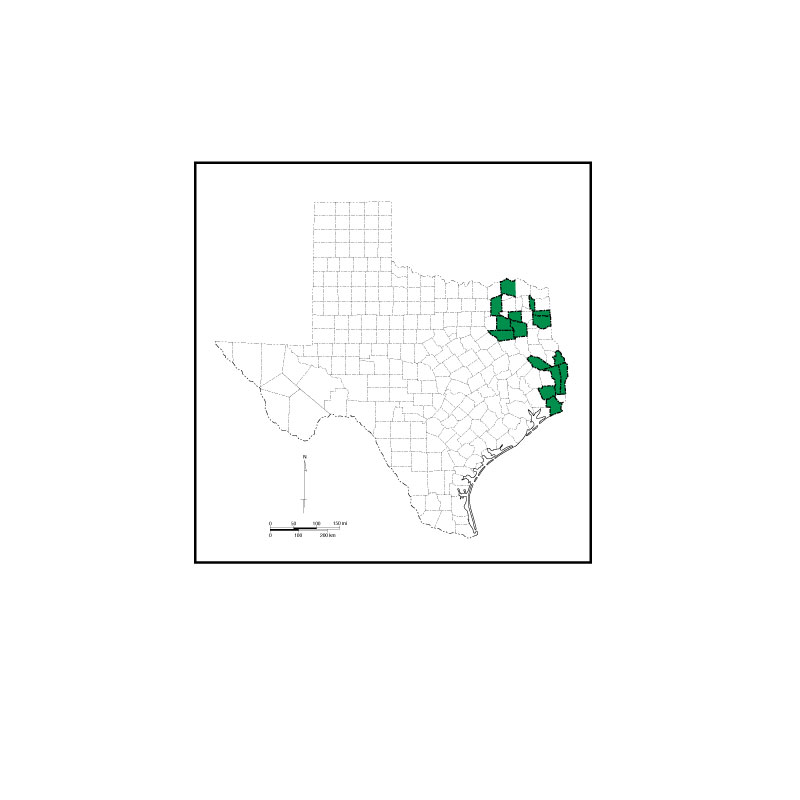
Texas distribution. In Texas, Cemophora coccinea is found along the east Texas border.
Habitat. Scarletsnakes prefer soft, sandy or loamy soils for burrowing, occurring in forested areas as well as open areas such as agricultural fields and along borders of swamps and stream banks. Occasionaly scarletsnakes are dug up from as deep as 2 meters (6 ft) during the construction of foundations or ditches for pipelines.
Reproduction. Clutches of eggs, ranging in size from 3-8, are laid in mid-summer and newly hatched young measuring 12-15 cm (5-6 in) in length.
Size. Northern scarletsnakes (Cemophora coccinea) are usually 35-51 cm (14-20 in) in length.
Map. Orange counties indicate new county records since previous Herps of Texas update in 1998; all other colored counties reflect known distribution prior to 1998 for species and/or subspecies. Map is based on museum voucher specimens.