Crotalus ornatus
Scientific name. Crotalus ornatus
Common Name. Eastern Black-tailed Rattlesnake
General information. Like all rattlesnakes, the Eastern Black-tailed Rattlesnake is venomous and should be left alone. Even though it is generally restricted to rocky habitats, C. ornatus can be found at a wide range of elevations up and down a hillside. blacktail rattlesnakes found along this large elevational gradient (1000-2500 m) can demonstrate extremes seen in background colorations. At lower elevations, the background colors of C. molossus are often gray or dusty brown, allowing the rattlesnake to blend in better with its sparsely vegetated and dry desert scrub surroundings. At higher elevations, such as the Davis Mountains in Jeff Davis County, the background colors are generally more yellowish, which contrast more strongly with the dark vertebral blotches and allow the rattlesnake to camouflage itself more effectively in the shadows created by the pinon-juniper woodland. The black-tailed rattlesnake is also thought to be one of the most passive rattlesnakes in the state, relying instead on its camouflage for protection against predators rather than using its attention-grabbing rattles to warn would-be attackers. The black-tailed rattlesnake eats a variety of vertebrate prey, feeding on mammals, birds and even lizards.
Protected status. The Eastern Black-tailed Rattlesnake is not a protected species in Texas and can be legally collected with a hunting license.
Diagnostic features. Undivided anal scale Dorsal scales extremely keeled, often in rows of 25-29 near midbody
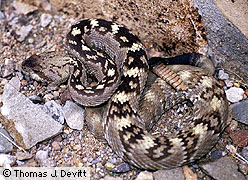
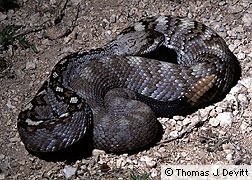
Coloration. Background color can be extremely variable, ranging from yellowish tan or olive to gray or dark brown A series of very dark blotches are found down the back with the posteriormost blotches forming crossbands Top or crown of the head is often dark brown or black and contrasts with the tan or yellow coloration of the rest of the head Chocolate brown ocular stripe runs through the eye into the corner of the mouth All-black tail is striking, and the black velvet color begins immediately at the vent and covers the entire tail.
General distribution. In the United States, Crotalus ornatus is found in Arizona, New Mexico, and Texas.
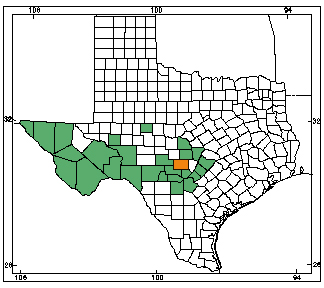
Texas distribution. C. ornatus is mostly found throughout the rocky areas of the Trans-Pecos, but has also occurred historically eastward to the edges of the Edwards Plateau, including Bandera and Travis Counties.
Habitat. The heavy-bodied Eastern Black-tailed Rattlesnake is most frequently encountered in rough and rugged mountain canyons and hillsides, though it is sometimes found crossing the flatland separating rocky areas.
Reproduction. Gravid (or pregnant) C. ornatus give birth to live young in the late summer, generally in July and August, which coincides with the onset of the summer monsoons. The neonate Eastern Black-tailed Rattlesnake may number between 3 and 16, and average around 27 cm (10.5 in) in length.
Size. Adults may measure 76-110 cm (30-42 in); record length is 125 cm (49 in).
Map. Orange counties indicate new county records since previous Herps of Texas update in 1998; all other colored counties reflect known distribution prior to 1998 for species and/or subspecies. Map is based on museum voucher specimens.