Eleutherodactylus cystignathoides
Scientific name. Eleutherodactylus cystignathoides
Common Name. Rio Grande Chirping Frog
General information. Eleutherodactylus cystignathoides is nocturnal and remains under cover during the day. Eleutherodactylus cystignathoides darts quickly under cover and can run as well as leap and hop.
Protected status. The Rio Grande Chirping Frog is not a protected species in Texas and can be legally collected with a hunting license.
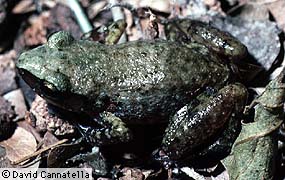
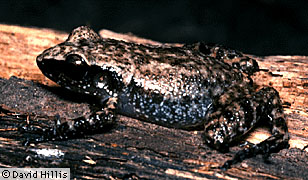
Diagnostic features. Flat, elongated body with pointed snout Toe pads and tubercles on toes
Coloration. Dorsal color varies from brown, gray, or yellow-green with dark spots present on dorsal surface. Ventral surface with translucent skin Dark crossbar pattern on hind limbs.
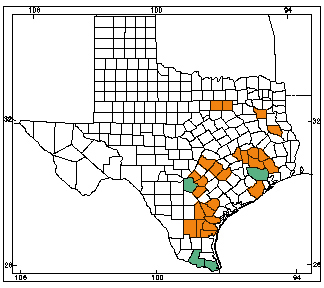
General distribution. In North America, Eleutherodactylus cystignathoides is found from south Texas to northeast Mexico.
Texas distribution. The single subspecies of Eleutherodactylus cystignathoides found in Texas, E. c. campi, is naturally found only in extreme south Texas; populations have been introduced around San Antonio, Houston, and La Grange.
Habitat. Eleutherodactylus cystignathoides makes its home in palm groves, backyard gardens, and irrigation ditches.
Reproduction. Breeding in Eleutherodactylus cystignathoides takes place in April and May; females lay no more than 12 large eggs.
Size. Eleutherodactylus cystignathoides grows to an adult size of 1.5-2.5 cm (0.5-1 in).
Calls.
Map. Orange counties indicate new county records since previous Herps of Texas update in 1998; all other colored counties reflect known distribution prior to 1998 for species and/or subspecies. Map is based on museum voucher specimens.