Eurycea chisholmensis

Scientific name. Eurycea chisholmensis
Common Name. Salado Salamander
General information. The Salado Salamander is completely aquatic, found in the vicinity of spring outflows, under rocks or in gravel substrate. Captive animals known to feed on amphipods.
Protected status. The Salado Salamander is listed as a federally threatened species by the U.S. Fish and Wildlife Service and can not be collected without a federally issued permit.
Diagnostic features. Flat head is long, with blunt and rounded snout. Eyes reduced Reddish-brown external gills. Well-developed tail fins Four toes on front feet, five on hind feet. Fifteen or sixteen costal grooves.
Coloration. Grayish-brown dorsal ground color with slight cinnamon tinge; a few light flecks may be present across dorsal surface Dorsal pigmentation appears as series of fine reticulations under microscope Sides of body and limbs cream-colored, with sides finely speckled and limbs densely speckled brown Head and face cream-colored with scattered flecks Gold stripe prominent on dorsal part of tail Sides of tail speckled with yellow; ventral tail surface with pale yellow line Ventral surface immaculate (and transparent).
General distribution. The entire distribution of Eurycea chisholmensis is restricted to two springs near Salado (Bell Co.), Texas.
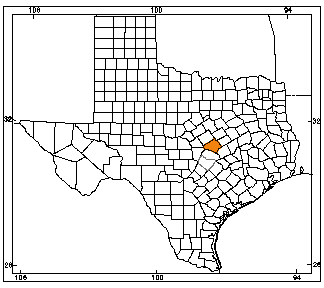
Texas distribution. Eurycea chisholmensis is known from Big Boiling and Robertson Springs at Salado, Bell County, Texas.
Habitat. Strictly aquatic, Eurycea chisholmensis is found only in two springs in Bell County.
Reproduction. Little is known about reproduction in this species. Juveniles are miniature versions of the adults.
Size. Maximum adult size in Eurycea chisholmensis is around 6 cm (2.25 in) total length.
Map. Orange counties indicate new county records since previous Herps of Texas update in 1998; all other colored counties reflect known distribution prior to 1998 for species and/or subspecies. Map is based on museum voucher specimens.