Eurycea neotenes
Scientific name. Eurycea neotenes
Common Name. Texas Salamander
General information. Eurycea neotenes remains under rocks and among the rock cobbles at the bottom of stream beds.
Protected status. The Texas Salamander is not a protected species in Texas and can be legally collected with a hunting license.
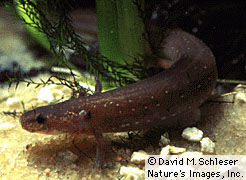
Diagnostic features. Slender body with short limbs. Bright red external gills. Finned tail. Four toes on front feet, five on hind feet Fifteen to seventeen costal grooves.
Coloration. Light brown to yellow with brown mottling. Two rows of lighter flecks on each side of body Dark bar from eye to nostril Pale cream-colored, translucent ventral surface.
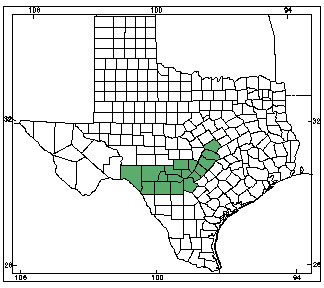
General distribution. Eurycea neotenes is restricted to central Texas.
Texas distribution. Eurycea neotenes is only found along the Balcones Escarpment from Comal County to Val Verde County.
Habitat. Strictly aquatic, Eurycea neotenes is found in subterranean streams and creek headwaters.
Reproduction. Little is known about reproduction in this species. One courtship sequence recorded in the lab took almost three hours from start to finish. Gravid females have been collected in the spring and early summer.
Size. Eurycea neotenes grows to adult lengths of 5-10 cm (2-4 in) total length.
Map. Orange counties indicate new county records since previous Herps of Texas update in 1998; all other colored counties reflect known distribution prior to 1998 for species and/or subspecies. Map is based on museum voucher specimens.