Eurycea rathbuni
Scientific name. Eurycea rathbuni
Common Name. Texas Blind Salamander
General information. Eurycea rathbuni feeds on a variety of invertebrates, including shrimp, snails, and amphipods.
Protected status. The Texas Blind Salamander is considered an endangered species by the Texas Parks and Wildlife Department and is fully protected by the state. Additional protection has been afforded to this species as the U.S. Fish and Wildlife Service considers the Texas blind salamander to be a federally endangered species.
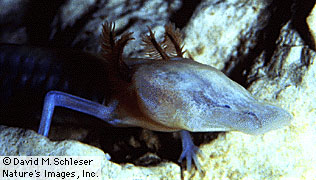
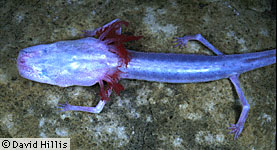
Diagnostic features. Large head with flattened snout. Reduced, vestigial eyes beneath the surface of the skin. Bright red external gills. Thin, elongate limbs; four toes on front feet, five on hind feet. Finned tail tapering at tip. Twelve costal grooves
Coloration. White to pale pink with translucent skin.
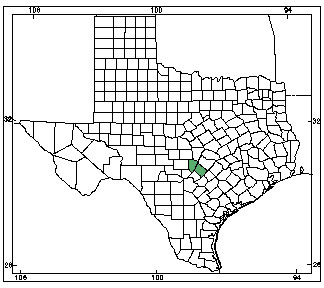
General distribution. Eurycea rathbuni is restricted to two counties in Texas.
Texas distribution. Eurycea rathbuni is found only in the Balcones Escarpment near San Marcos, Hays County.
Habitat. Eurycea rathbuni is found in the subterranean streams of the Purgatory Creek system, and is only found above ground when water flow brings it to the surface.
Reproduction. Little is known for Eurycea rathbuni, except that gravid females can be observed throughout the year.
Size. Adult Eurycea rathbuni can measure between 9-13.5 cm (3.5-5.5 in) total length.
Map. Orange counties indicate new county records since previous Herps of Texas update in 1998; all other colored counties reflect known distribution prior to 1998 for species and/or subspecies. Map is based on museum voucher specimens.