Eurycea waterlooensis

Scientific name. Eurycea waterlooensis
Common Name. Austin Blind Salamander
General information. Little is known from wild populations. Obligately aquatic, lives in the aquifer. A majority of observations occur November to January. An adult flushed from the aquifer defecated remains of amphipods, copepods, ostracods, and plant material.
Protected status. The Austin Blind Salamander is listed as a federally endangered species by the U.S. Fish and Wildlife Service and can not be collected without a federally issued permit.
Diagnostic features. Snout elongate and flattened Body flattened ventrally External eyes absent External gills. Weakly developed tail fins Four toes on front feet, five on hind feet. Twelve costal grooves.
Coloration. Pearly white luster dorsally with light distribution of pigment across entire dorsal surface Ventral surface white and unpigmented.
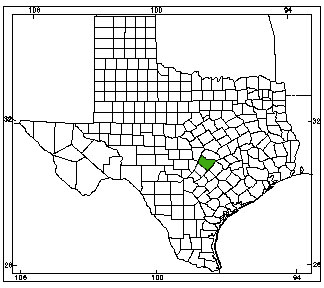
General distribution. Eurycea waterlooensis is found only in the outlets of Barton Springs in Travis County, Texas.
Texas distribution. Eurycea waterlooensis is found only at three of the four outlets of Barton Springs (Parthenia, Eliza, and Sunken Gardens Springs) in Travis County, Texas.
Habitat. Strictly aquatic, Eurycea waterlooensis likely spends most of its life underground in the subterranean cavities of the Edwards Aquifer.
Reproduction. Unknown. Individuals raised in captivity from juveniles to adults in eight months.
Size. Maximum adult size in Eurycea waterlooensis is 6-7 cm (2-3 in) total length.
Map. Orange counties indicate new county records since previous Herps of Texas update in 1998; all other colored counties reflect known distribution prior to 1998 for species and/or subspecies. Map is based on museum voucher specimens.