Liodytes rigida

Scientific name. Liodytes rigida
Common Name. Glossy Crayfish Snake
General information. The non-venomous Liodytes rigida feeds predominantly on freshly molted crayfish, though a variety of fish, amphibians, and various insects have been documented as food items. Usually only seen above ground during times of heavy rains, R. rigida can also be found by digging into the moist soils under logs, boards, and stones found near the water’s edge. They are not known to bite, even when handled by humans. Nocturnal, the activity of this crayfish snake lasts from March to November.
Protected status. The Glossy Crayfish Snake is not a protected species in Texas and can be legally collected with a hunting license.
Diagnostic features. Despite its shiny appearance, Liodytes rigida has keeled dorsal scales (in 19 rows at midbody) Divided anal plate.
Coloration. Background color is a shiny olive-brown, with a dull yellow lateral stripe found along the first and second scale rows A thin dark line bisects the lateral stripe. The ventral surface is usually yellowish with a medially placed double row of pigmented, half-moon shaped spots.
General distribution. Liodytes rigida is found along the Gulf of Mexico, from Florida and Georgia to the east, to the wetter portions of eastern Texas and Oklahoma; they, however, are not found along the Mississippi Delta in Louisiana.
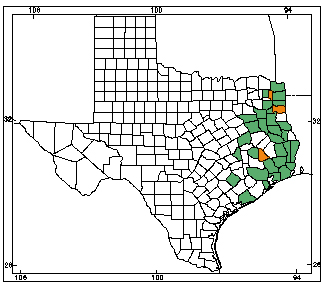
Texas distribution. The single subspecies of Liodytes rigida found in Texas, L. r. sinicola (the Gulf Crayfish Snake), is a reclusive snake found only in the extreme eastern portions of the state.
Habitat. The Glossy Crayfish Snake, an uncommonly seen small snake because of its nocturnal feeding habits and subterranean lifestylefound, is exclusively found in the eastern quarter of the state.
Reproduction. Liodytes rigida is a live-bearing snake, breeding in the spring and giving birth to young during the summer. The juvenile snakes measure 16.5-23 cm (6.5-9 in) at birth.
Size. Liodytes rigida a small species of snake, with adults generally measuring 35.5-61 cm (14-24 in).
Map. Orange counties indicate new county records since previous Herps of Texas update in 1998; all other colored counties reflect known distribution prior to 1998 for species and/or subspecies. Map is based on museum voucher specimens.