Micrurus tener
Scientific name. Micrurus tener
Common Name. Texas Coral Snake
General information. The Texas Coral Snake is venomous and should be treated with great respect and viewed only from a distance. Coral snakes are not generally aggressive and will most likely flee any confrontation if given a chance to retreat. A member of the family of snakes which also includes cobras, the Texas coral snake’s venom is much like that of its relatives in that it is neurotoxic. A neurotoxin affects the respiratory and nervous system of an envenomated animal and it allows the coral snake to subdue its prey without worry of an injury during a struggle. The Texas coral snake has small fangs in the front of its mouth (fangs which do not hinge like those of a rattlesnake) and will repeatedly strike its prey in order to deliver its venom. The Texas coral snake can often be found under boards or large stones during certain times of the year, living in places where other snakes may likely be encountered. The Texas coral snake feeds almost exclusively on other snakes, though a few smooth scaled skinks may be eaten from time to time.
Protected status. The Texas Coral Snake is not a protected species in Texas and can be legally collected with a hunting license.
Diagnostic features. Divided anal scale. Dorsal scales smooth, in rows of 15 near midbody
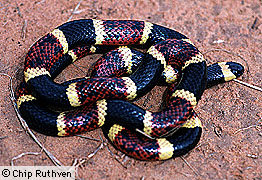
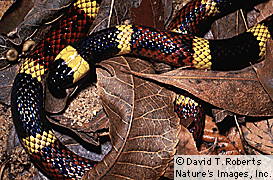
Coloration. A series of black, yellow, and red bands that completely encircle the body, with the red bands only touching adjacent yellow bands Anterior portion of the head is black and the red bands of the body are not entirely red, with specks of black pigment found within each red band No red bands found on the head or on the tail, these areas only have yellow and black bands.
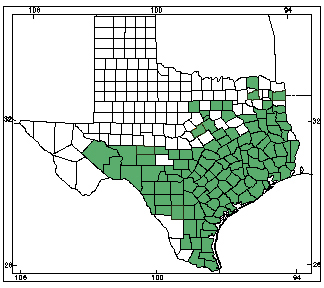
General distribution. In the United States, Micrurus tener is found in Texas, Louisiana, and Arkansas; additionally, it can be found in many of the northeastern states of Mexico.
Texas distribution. Micrurus tener is common through the southern thorn-scrub portions of the state as well as the pine forests of the east. The Texas coral snake can also be found into the oak-juniper woodland areas of the Edwards Plateau and the eastern stretches of the Trans-Pecos.
Habitat. The Texas Coral Snake can commonly be found in wide variety of habitats, habitats generally consisting of moist vegetation or humid surroundings.
Reproduction. Texas Coral Snakes are egg-layers, laying clutches of 7 to 9 eggs in June or July. The young coral snakes hatch about two months later, measuring between 16.5-24 cm (6.5-9.5 in).
Size. Adult Texas Coral Snakes measure between 51-76 cm (20-30 in) in length, with record individuals measuring just under 121 cm (48 in).
Map. Orange counties indicate new county records since previous Herps of Texas update in 1998; all other colored counties reflect known distribution prior to 1998 for species and/or subspecies. Map is based on museum voucher specimens.