Notophthalmus viridescens
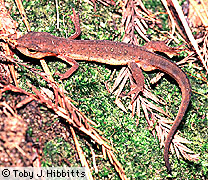
Scientific name. Notophthalmus viridescens
Common Name. Eastern Newt
General information. Adult Notophthalmus viridescens find shelter among submerged rocks and feed on insects, mollusks, leeches, and small amphibians. They have toxic secretions from skin glands with which to deter predators. The eft is terrestrial and is active during or after rains.
Protected status. The Eastern Newt is not a protected species in Texas and can be legally collected with a hunting license.
Diagnostic features. Adult: stout newt with relatively small head, short limbs, and a vertically compressed tail. Eft: rounded tail
Coloration. Adult: yellow-brown to dark brown dorsum and yellow venter with numerous black spots on ventral surface. Eft: red-orange color with little spotting.
General distribution. In North America, Notophthalmus viridescens is found from Lake Superior south to Texas and eastward to South Carolina.
Texas distribution. In Texas, Notophthalmus viridescens is found in the eastern third of the state.
Habitat. Adult Notophthalmus viridescens are found in the shallow waters of streams with vegetative cover, such as in ditches, swamps, and ponds. Land-stage efts are found on the forest floor.
Reproduction. Breeding in occurs in late winter to early spring. Females lay up to 200-400 eggs and attach them singly to submerged vegetation in shallow waters.
Size. As adults, aquatic Notophthalmus viridescens grow to 6-13 cm (2.5-5.5 in) total length Terrestrial efts of this species grow between 3-8 cm (1.4-3.4 in) in total length.
Map. Orange counties indicate new county records since previous Herps of Texas update in 1998; all other colored counties reflect known distribution prior to 1998 for species and/or subspecies. Map is based on museum voucher specimens.
