Pantherophis bairdi
Scientific name. Pantherophis bairdi
Common Name. Baird’s Ratsnake
General information. This ratsnake is slow-moving and generally calm. Pantherophis bairdi will hiss and may strike if threatened. Feeds on small mammals (including bats), birds, and lizards.
Protected status. Baird’s Ratsnake is not a protected species in Texas and can be legally collected with a hunting license.
Diagnostic features. Scales are faintly keeled, with 27 scale rows at midbody Divided anal plate.
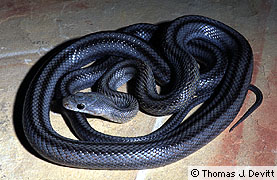
Coloration. Dorsal color is grey-brown with scales edged in yellow or orange-yellow on forebody and deep orange or salmon toward rear Adults with four dark longitudinal stripes. Ventral surface light grey to pale yellow but darkens to salmon under tail.
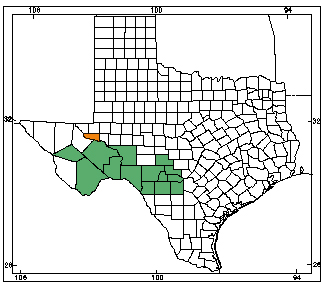
General distribution. In North America, Pantherophis bairdi is found only in portions of Texas and northern Mexico.
Texas distribution. In Texas, Pantherophis bairdi is found from south-central Texas to Big Bend.
Habitat. Pantherophis bairdi can be found across rocky, wooded areas of Cretaceous limestone canyons of the Edwards Plateau and upland and desert parts of the Trans-Pecos.
Reproduction. Breeding takes place in early summer and a clutch of up to 10 eggs is laid mid-summer. Incubation lasts about 12 weeks. Hatchlings are 12 inches long and marked with gray and brown blotches. These blotches slowly fade into the background coloration of the snakes as they become adults, gaining the longitudinal stripes as the blotches disappear
Size. Adult Pantherophis bairdi can grow to lengths of 62.5-137.5 cm (25-55 in).
Map. Orange counties indicate new county records since previous Herps of Texas update in 1998; all other colored counties reflect known distribution prior to 1998 for species and/or subspecies. Map is based on museum voucher specimens.