Plestiodon tetragrammus
Scientific name. Plestiodon tetragrammus
Common Name. Four-lined Skink
General information. This species of diurnal skink eats insects and spiders found among the leaf litter. This skink finds shelter in burrows or under rocks.
Protected status. The Four-lined Skink is not a protected species in Texas and can be legally collected with a hunting license.
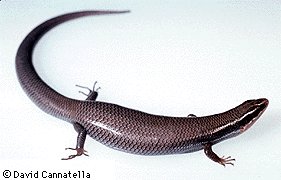
Diagnostic features. Cylindrical skink with glossy scales and small limbs.
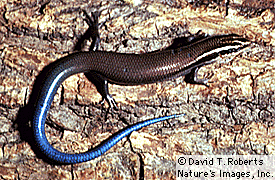
Coloration. The two subspecies of Plestiodon tetragrammus in Texas are differentiated by the length of their dorsal black bands: P. t. tetragrammus - dorsal pattern consists of a broad black band bordered by light lines from the eye down each side of the back that extends to the hind legs. P. t. brevilineatus - dorsal pattern consists of a broad dark band bordered by light lines from the eye down each side of the back that ends behind the foreleg (also with light “Y” on top of head).
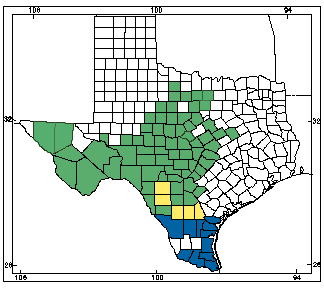
General distribution. In North America, Plestiodon tetragrammus is found from south Texas to northern Veracruz, as well as the Mexican states of Queretaro, Nuevo Leon, Tamaulipas, Coahuila, and Chihuahua.
Texas distribution. In Texas, the two subspecies of Plestiodon tetragrammus cover the western, central and southern portions of the state.
Habitat. Plestiodon tetragrammus brevilineatus prefers rocky areas in wooded environments and is commonly seen among leaf litter. Plestiodon tetragrammus tetragrammus is found in more arid regions where it prefers grassy areas, but is also seen in palm groves and wooded areas.
Reproduction. Breeding times are not known. Females lay 5-12 eggs in depressions and female brooding is exhibited. Hatchlings of both subspecies have light stripes and bright blue tails (P. t. tetragrammus hatchlings may have an orange head).
Size. Plestiodon tetragrammus grow to adult lengths (total length, including tail) of 12.5-17.5 cm (5-7 in).
Map. Colored counties reflect subspecies. Map is based on museum voucher specimens; last updated 12 November 2014.