Pseudacris streckeri
Scientific name. Pseudacris streckeri
Common Name. Strecker’s Chorus Frog
General information. Pseudacris streckeri is nocturnal, feeding on insects. Pseudacris streckeri can burrow into the soil with its front limbs to shelter itself from heat and predation.
Protected status. Strecker’s Chorus Frog is not a protected species in Texas and can be legally collected with a hunting license.
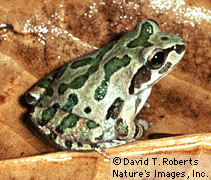
Diagnostic features. Large, stout frog with its toes slightly webbed with disks at tips
Coloration. Varies from gray, brown, olive, to green ground color Dark stripe through eye as well as a dark spot under the eye Dark spots run longitudinally along back. Deep yellow or orange coloration in groin.
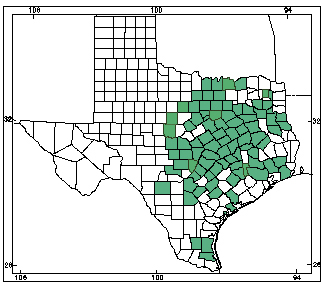
General distribution. In North America, Pseudacris streckeri is found in a broad band through central and eastern Oklahoma and Texas.
Texas distribution. The single subspecies of Pseudacris streckeri in Texas, P. s. streckeri, is found in the eastern half of the state.
Habitat. Pseudacris streckeri is seen in moist woodland areas, rocky ravines, near streams, in swamps, or in cultivated fields.
Reproduction. Breeding occurs from November to April or May in Pseudacris streckeri. Eggs are laid in water and attached to vegetation.
Size. Pseudacris streckeri reaches an adult length between 2.5-4 cm (1-1.5 in).
Calls.
Map. Map is based on museum voucher specimens; last updated 12 November 2014.