Regina grahamii
Scientific name. Regina grahamii
Common Name. Graham’s Crayfish Snake
General information. Recorded food items for the non-venomous Regina grahamii are mainly crayfish, though salamanders, tadpoles and adult frogs, and snails have been found in the stomachs of this snake species. Mainly nocturnal during the summer, R. grahamii can be sometimes be found basking in the early morning hours, particularly in the spring and the fall. This species can also be found hiding in crayfish burrows along stream banks.
Protected status. The Graham’s Crayfish Snake is not a protected species in Texas and can be legally collected with a hunting license.
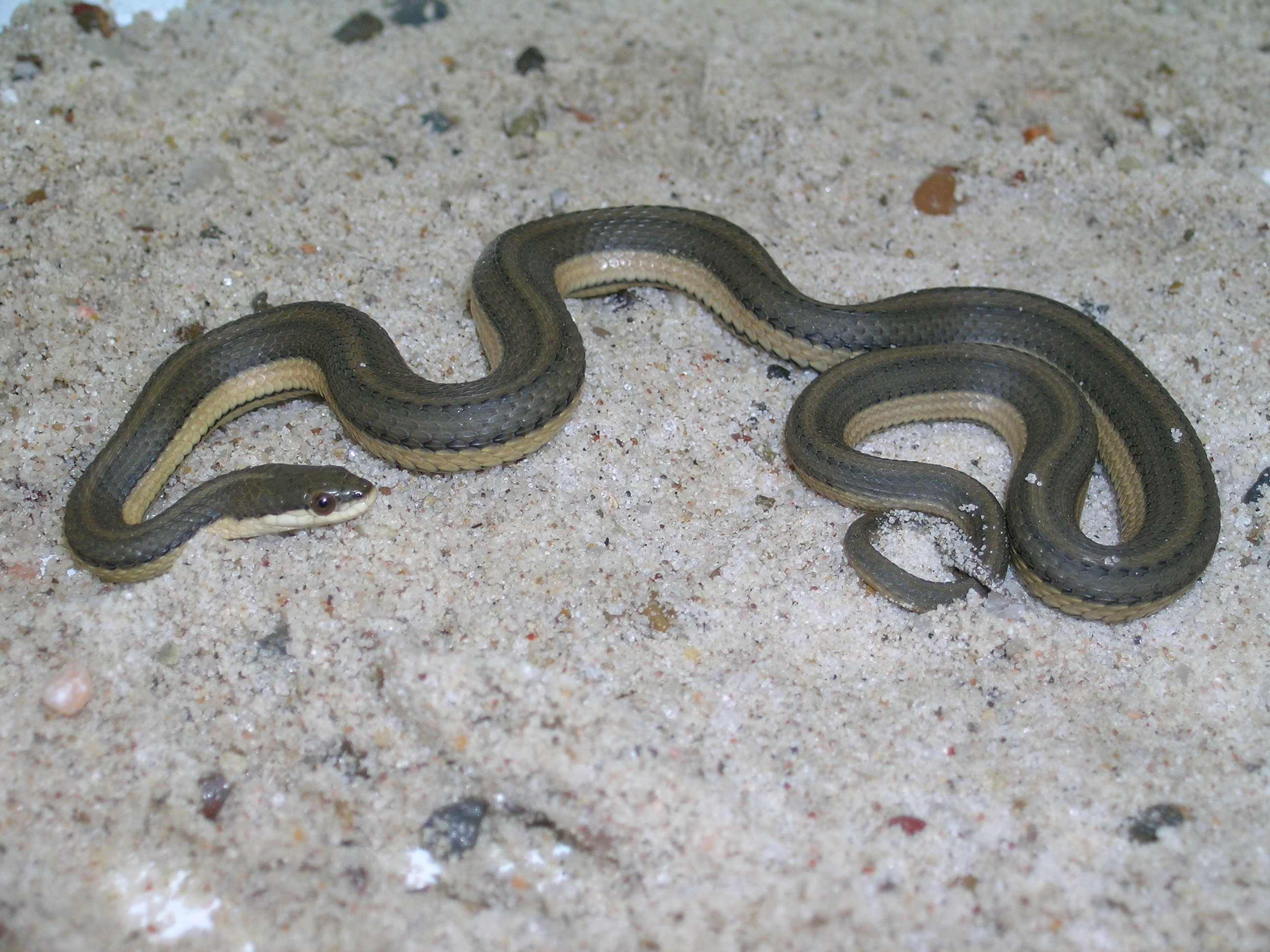
Diagnostic features. Keeled dorsal scales, in rows of 19 at midbody Divided anal plate
Coloration. Dorsal surface is olive, with the exception of a light colored lateral stripe found along the first three dorsal scale rows. A broken line of black pigment is found along the border of the first dorsal scale row and the ventral scales. Ventral surface is usually yellowish with a row of dark spots found medially, although individuals may be found with immaculate bellies.
General distribution. Regina grahamii is found throughout portions of the Midwest and the South, from Iowa and Illinois south to Louisiana and Texas.
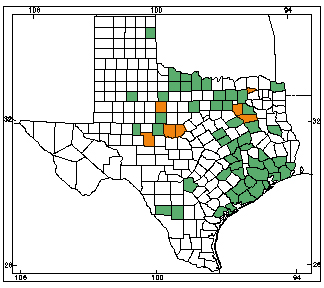
Texas distribution. In Texas, Regina grahamii is found through much of the eastern third of the state, from the eastern border with Louisiana west to the aquifers of the Balcones Fault, with the distribution additionally extending into parts of the Panhandle and North Texas.
Habitat. Not a commonly found snake, Graham’s Crayfish Snake is a semi-aquatic snake found near the edge of ponds and streams of eastern Texas, as well as in various flooded pastures and bottomlands.
Reproduction. Regina grahamii is viviparous or live-bearing, breeding at night in April and May, and giving birth to 6-25 young in August or September. Young measure 17.5-27 cm (7-10.5 in) at birth.
Size. Typically small snakes, adult Regina grahamii measure 46-71 cm (18-28 in), but occassionally reach lengths of 119 cm(47 in).
Map. Orange counties indicate new county records since previous Herps of Texas update in 1998; all other colored counties reflect known distribution prior to 1998 for species and/or subspecies. Map is based on museum voucher specimens.