Sceloporus cyanogenys
Scientific name. Sceloporus cyanogenys
Common Name. Blue Spiny Lizard
General information. This diurnal lizard shelters in rock crevices. Sceloporus cyanogenys feeds primarily on flying insects, but eats other insects, as well.
Protected status. The Blue Spiny Lizard is not a protected species in Texas and can be legally collected with a hunting license.
Diagnostic features. Largest of spiny lizards Long tail
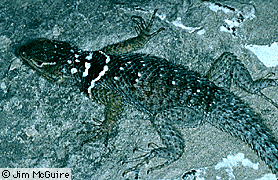
Coloration. Dorsal ground color is gray or brown Dorsal pattern varies with sex, but both sexes have a dark band across the neck bordered on both sides by a lighter pigment. Tail is vaguely banded with dusky color. Head and limbs are dark brown. Males with metallic green or blue on back and tail with white flecks; male also with blue chin and throat, and blue belly patches Females and young lack blue-green coloration and belly patches.
General distribution. In North America, Sceloporus cyanogenys is found from south Texas to northeastern Mexico.
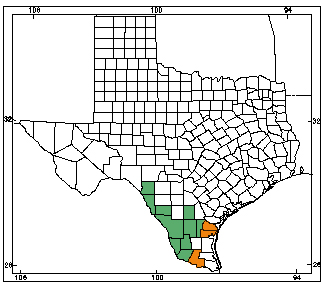
Texas distribution. In Texas, Sceloporus cyanogenys is found in south Texas, primarily along the Rio Grande Valley from Kinney County to Cameron County.
Habitat. Sceloporus cyanogenys prefers rocky terrains in arid and semi-arid environments where it is commonly seen on boulders, rock piles, cliffs, bridges, and in dry creekbeds.
Reproduction. This live-bearing lizard gives birth to young from February to June with as many as 18 young per litter.
Size. The largest species of spiny lizard in Texas, Sceloporus cyanogenys grows to lengths (total length including tail) of 12.5-35 cm (5-14 in).
Map. Orange counties indicate new county records since previous Herps of Texas update in 1998; all other colored counties reflect known distribution prior to 1998 for species and/or subspecies. Map is based on museum voucher specimens.