Scincella lateralis
Scientific name. Scincella lateralis
Common Name. Ground Skink
General information. This diurnal skink is wary and quickly retreats when approached. This species forages for insects in leaf litter and has snake-like movements.
Protected status. The Ground Skink is not a protected species in Texas and can be legally collected with a hunting license.
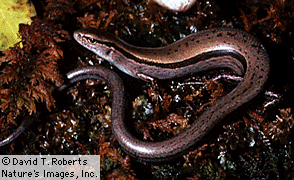
Diagnostic features. Short limbs with a comparatively long tail, about 2.5 times the head-body length.
Coloration. Dorsal ground color varies from rusty or golden brown to brown. Dorsal pattern consists of a black dorsolateral line from the eye onto the tail. Ventral surface is light and unmarked.
General distribution. In North America, Scincella lateralis has a broad range from New Jersey to Kansas and through much of the southern U.S. to the Gulf of Mexico.
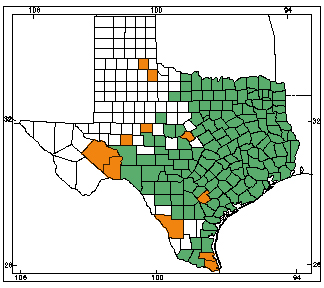
Texas distribution. In Texas, Scincella lateralis is found in the eastern half of the state and the western reaches of central Texas.
Habitat. Scincella lateralis is often observed in moist, humid, wooded environments among the leaf litter or other debris, but is also common in urban gardens.
Reproduction. Breeding takes place from January to August. Females may lay up to 7 eggs as many as five times during the season. No parental care is exhibited.
Size. Scincella lateralis is one of the smallest skink species in Texas, only growing to a total adult length of 7.5-12.5 cm (3-5 in).
Map. Orange counties indicate new county records since previous Herps of Texas update in 1998; all other colored counties reflect known distribution prior to 1998 for species and/or subspecies. Map is based on museum voucher specimens.